Wednesday, October 9, 2019

Isbel G takes a quick shot through the 26inch Cassegrain Reflector at Robinson Observatory

Member Isbel G. took this picture of the planetary nebula M57 (Ring Nebula) in Lira, using the 26" reflecting telescope of the NJAA observatory in High Bridge, NJ in Bortle Class 5 sky. 

The shots and the processing were quite simple and the results too, but he was happy because it is amoung the first photos of a deep sky object that he's taken since he arrived in this country, almost 4 years ago. 

Reflector, 26", Nikon D3000, combination of 3, 1 minutes photos, ISO 3200, stacked and processed with Photoshop.

Keith

Metuchen, New Jersey had a good turn out for their star party....

... and there were many young adults that hung with us throughout the cloudy hours. Metuchen  is a suburb of New York City and it's Bortle Class is 8... that's next to highest light pollution on the Bortle scale which goes from 1 to 9.
However, Jupiter, the half-Moon and Saturn were the first things to look at and they looked great under a good seeing sky. There was a six inch and an eight inch Dobsonian that got the kid's attention right away with their awesome views but it was my little 4.5 inch Star Blast from Orion that really impressed them! I love bringing it to star parties because it's a great contrast to the larger more expensive scopes.
They were surprised to see the quality of the optics and also tended to compare it to the two larger scopes on their own.
The older kids kept coming back to my little scope and finally asked how much it cost... it's reasonable price was one more reason they said they liked it.
Of course, I collimated the scope just before everyone showed up.... to make sure it stood up to the scrutiny. That took all of about two minutes!
Then I put my wide field eyepiece in place and they saw the half-Moon and Saturn together in one view!
Deal closed!!!
The older kids stuck around for almost two hours waiting for the clouds to break and every now and then they'd get to see a double star before the clouds filled in again. Earlier, they also saw the International Space Station fly-by and that garnered many wow's too! Considering it's been soaring overhead for more than twenty years, it still never get's old.

Considering that the night sky was mostly cloudy, I'd say mission accomplished!

       L-R: Wayne Petko, Ethan Catalanello, Sarah Terracinoa, Dave Nelson, Keith Marley

A good tool for getting a site's Bortle Class  number for it's light pollution rating, download "Clear Outside" app by First Light Optics to your phone. The device's GPS will give you the Bortle Class number based on your location and you can save several sites to it. As you can see in the photo below, other helpful information is also provided.
Keith
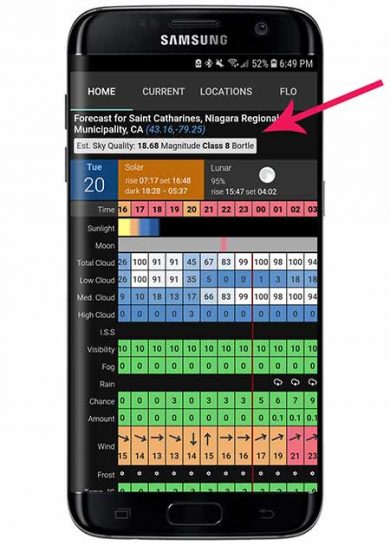
 How to find your Bortle Scale class

Wednesday, October 2, 2019

Africano Comet C/2018W2

Al Ernst writes "It has not been as hot a year for comets but this was easily seen on my sensor for a week.  Finally imaged it on the morning of September 28th.  
15 x 2 minute subs
NP127is 
F5.2 
QSI583 and green filter.  
Estimated magnitude was 9.
Thanks for the image, Al.


Keith

Wednesday, September 11, 2019

The New Jersey Astronomical Association is having an Open House/Flea Market Sep 21 10am to 4pm

News FLASH!
NJAA's 3rd annual open house and flea market is about to happen.... there's less than ten days left and there are still some sales spaces left!
So grab your old astro gear that you want to sell and bring it to the observatory a half hour before it starts ~ be there by 9:30am.... but first:
You must REGISTER by contacting Michael Franzyshen ( MichaelF@ascendant.com ) as space is limited.

See the flier at:   https://njaa-openhouse.org


Hope to see you there!
Keith

Thursday, August 15, 2019

Al Ernst took this great shot of the Milky Way while at the Golden State Star Party near Mount Lassen, California during the early days of July.
Al used a Canon 6D with a Canon 35mm lens and a STC Duoband Filter at ISO 1600 making 20x2min subs on an IOptron Tracker.
His SQM was 21.95

I don't think I've ever seen so many stars in one shot... and this is only a small portion of the Milky Way!
Amazing!
Thanks Al.
Keith


Sunday, June 16, 2019

Because it was such a beautiful evening last night, I decided to take out my 102mm, f7, 714mm fl Explore Scientific and with my ZWO ASI120MM camera, try to get something of the moon and Jupiter. I took quite a few shots of both as it was so pleasant outside. Here is Jupiter with Ganymede's shadow on it using Registax6 and Photoshop CS5. I'll look at the moon images later to see how they came out.
Keith

Sunday, June 2, 2019

Result of using a Duo Band Ha-Oiii filter

Al Ernst writes:  
Club members might be interested in this experiment.

I recently purchased a duo-band Ha-Oiii filter. It was installed on a STL4020cm one shot color camera and used with the telescope at St Joseph HS observatory in Metuchen, NJ where the light pollution yields an SQM of 18.3.

Thus, a worse case scenario.

Images were tried of a star cluster, a galaxy and a planetary nebula ~ M97.
Only the latter came out well.

Club members with DSLRs or OSC cameras might want to give this approach a try.

C-14 f7 at St Joseph HS Observatory in Metuchen, NJ
SBIG STL4020cm with duo-band Ha-Oiii filter
23x5 minutes
1x1 bin
-20°c
Processed in Nebulosity and Photoshop by Al Ernst and Rick Kelly

Thanks for the heads up Al.
I also read in the current Sky & Telescope that Lumicon has released their "new and  improved" Generation-3 Oiii filter.... and the price seems right too ~ $100 for the 1.25" version and $200 for the 2 inch! Here's Al's image using the impressive duo-band Ha-Oiii filter.   - Keith


Friday, May 24, 2019

Images taken with the 5inch Takahashi in Luna 1 Observatory

Vlad Alexandrov uses the Luna 1 observatory frequently and offered these three images for the blog.

The first image is of the beautiful spiral, the Triangulum galaxy(M33), about 3mil lys away he used over three hours of Luminosity and 80 min Red, 80 min of Green and 80 min of Blue light taken in October 2017. He stacked the images in Pixnsight then processed in Pixnsight and Photoshop.


The next shot is of the Horsehead Nebula, also known as Barnard 33, which is much closer at about 15lys away from Earth and very difficult to see visually, especially here in New Jersey! 
He use 4 hours of narrow band Ha light over many nights due to various weather conditions during November and December 2017. Vlad also used darks and flats as well, stacking it all together using Pixnsight and then processing it in Pixnsight and Photoshop. 


And last but not least; he took this great shot of the even further away Coma Galaxy Cluster, at a mean distance of about 325 mil lys from Earth on January 26th, 2018. He using 3 hours of Luminosity staking with Pixnsight and processing with both Pixnsight and Photoshop.


This is impressive work Vlad, thank you for sharing!
Keith

Thursday, May 9, 2019

The California nebula with a surprise!

Al Ernst took this image of the central area of the California nebula with asteroid Semiramis entering at the lower left.  Semiramis shows as a small streak in the lower left quadrant (at the left end of my red line).
  
Al tells us further that: "Semiramis was the much revered queen of Assyria who may have built the Hanging Gardens of Babylon".  
The image was taken with NP127is, QSI camera, and H alpha filter from Bridgewater, NJ.

 Thanks Al,
Keith

Monday, May 6, 2019

Threading The Needle (Galaxy)

At 10:40pm EDT on April 28, 2019, long-time member Perry Arts was imaging in his backyard in Branchburg, New Jersey. He was taking a series of pictures of the "Needle Galaxy"/ NGC4565 when an airplane tried to improve his view!
Here's the result:

The plane's presence kept Perry from trying to post process the image further, but he thought that "sometimes the fates align", so he presented it at the club's Astrophotography/Research meeting last week and everyone loved it!
After all, he said, "what are the chances that he would capture a fast moving plane precisely at that very a small part of the sky and be perfectly aligned with the galaxy"?
We all couldn't agree more, so here it is....
Hopefully Perry will send the finished image of the Needle so I can post it here with his artsy photo.
Keith
(PS ~ we think the two red "things" are the twin jet engines lit by the flashing red light.Unless, of course, it's the USS Enterprise NCC 1701-D entering warp!)